
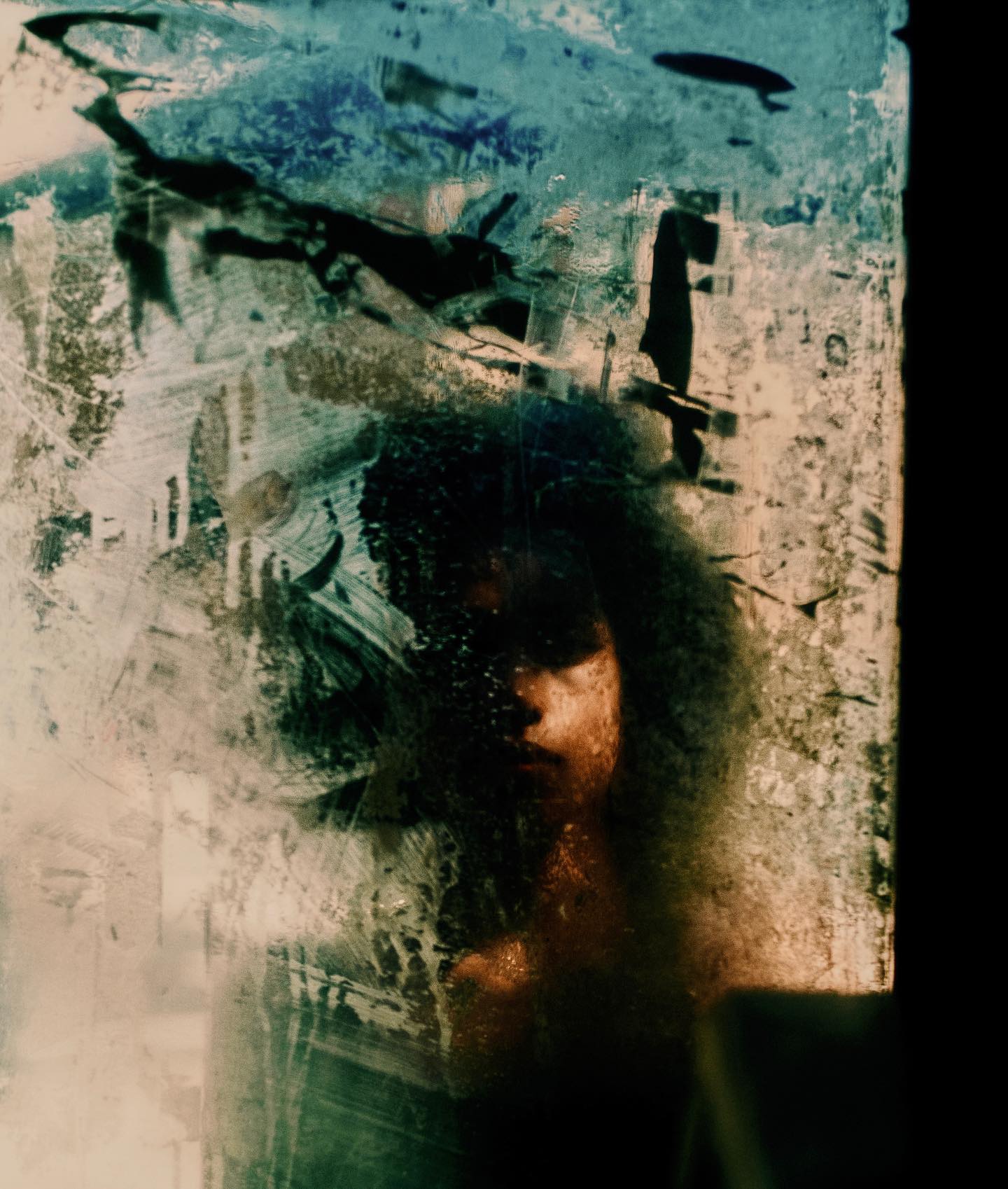
For most of his career Jack Davison has made portraits by putting something in the way. Smoke curling across a mouth. A face seen through a sheet of Perspex, or in a puddle on the pavement, or split by a shard of glass held up to the eye. The pictures were dreamlike and hard to place, and they led Kathy Ryan of The New York Times Magazine to say he was reinvigorating the magazine portrait. His new work removes every one of those devices. The question is why.
Part of the answer is in how he learned. Davison never went to photography school. He studied English at Warwick and taught himself on Flickr, in an era when photographs are made, seen and forgotten in the same afternoon. A picture taken in 2024 looks like 2024: the hair, the earbuds, the logo on the jacket. The glass and the water were one way of escaping that. It seems he wanted a harder way.

In November 2024 he went into the street with the casting director Coco Wu and photographed about ninety Londoners in three days. Head and shoulders, black and white, almost all in the same plain hood. "Sometimes the hair was too modern or specific, so the hood is an equaliser," he said. "It hides everything apart from the face." No jewellery, no headphones. Only one sitter in the whole series looks into the lens.
The result is stranger than anything he made with smoke and mirrors. With nothing to place them, the faces drift out of their own decade. Some look like mugshots, some like saints in a side chapel, some like Victorian silhouettes. He has said he likes the idea of the book being found one day "by someone in the future who has no idea how old the pictures are." That is a remarkable ambition for a photographer born in 1990, and the hood is only half of how he gets there.

The other half is ink. He spent three years learning etching at a workshop in Brixton, and now prints his black and white work as gravures: the image is etched into a plate, covered in ink, wiped and pressed into paper. "You can make it more painterly by brushing less ink away," he said. The blacks come out deep and uneven, and some faces sink so far into shadow they become almost stencils. The pictures were taken quickly, digitally, in the street. The prints look like they were found in a drawer.
What he has worked out is that the strongest obstruction is not glass or smoke. It is time. Remove every sign of the present and a face becomes very old and very new at once. London is meant as the first city of many. He plans to do the same somewhere new every year.

"There's something about a face that can change on a dime. It can change in light, in tone, in mood."