
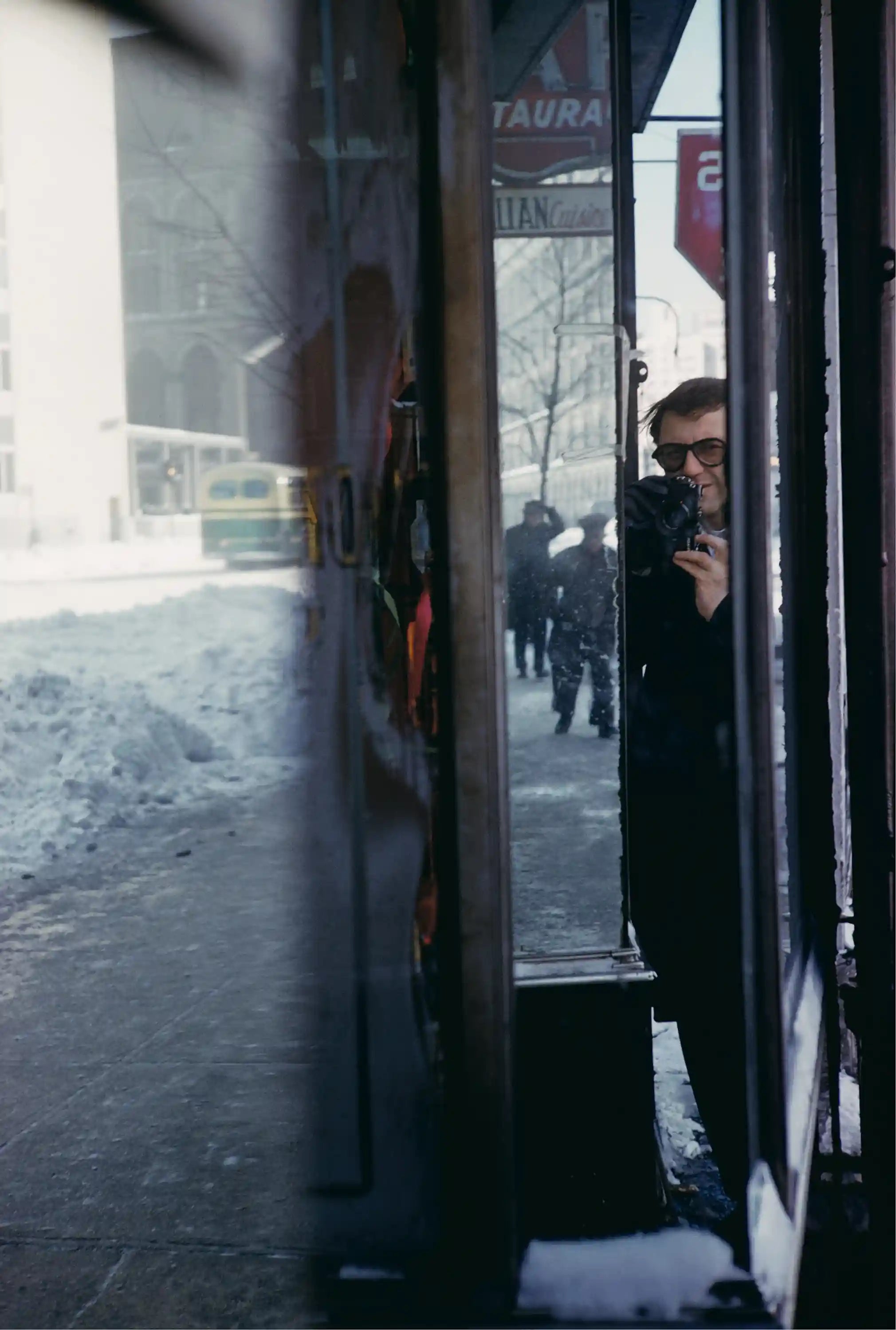
Saul Leiter's photographs are full of things in the way: steam on a window, the edge of an awning, the back of a stranger's coat, a wall of shadow that swallows half the frame. It is tempting to call this a style. It makes more sense as a way of living, and his life explains it.
He was the son of a celebrated rabbi in Pittsburgh, raised to follow him. In 1946, at twenty-two, he left rabbinical school and came to New York to paint. His father disowned him. Leiter never took up the idea that a man should be important, or that his work needed to be seen. He painted for the rest of his life, and took photographs on the side, in colour, at a time when colour was what advertising used and serious photographers avoided.

Look at Canopy, from 1958. A snowstorm has turned the street almost white. A dark canopy cuts across the top of the picture like a curtain half lowered, and beneath it people push through the snow. The only colour left is a car's brake light. Most photographers would have stepped out from under the canopy to get a clear view. Leiter stayed where he was and let the canopy become the picture. That is a painter's decision, about mass and colour more than event, and it is also a temperament. He liked standing back. He once spoke of "the tremendous advantage of being unimportant," and he meant it: nobody was waiting for his pictures, so he could take the ones nobody else wanted.

For a while the world noticed. Edward Steichen included him in a show at MoMA in 1953, and Harper's Bazaar ran his colour fashion work from 1959. Then he faded from view, and seemed content. "I always assumed I would simply be forgotten and disappear from view," he said. He was in his eighties when a book of his early colour work finally made him famous.
The Unseen Saul Leiter shows how much he did while nobody was looking. He left more than 40,000 colour slides, perhaps 60,000, most of them never printed, sorted into boxes under labels in his own hand. One box was marked "Personal Park and Lovers." From it comes a man smiling on a park bench as he is kissed, photographed from above, with a railing covering more than half the frame. The kiss is almost an afterthought. The railing is what he saw.

Michael Greenberg called his photographs "the embodiment of the oblique, the peripheral, the ricochet." That describes the man as well as the pictures. Leiter spent his life at the edge of things by choice. The photographs are what the world looks like from there: quieter, more beautiful, and always partly hidden.

"A window covered with raindrops interests me more than a photograph of a famous person."
The Unseen Saul Leiter is available at Parallel Editions.